Showing posts with label sacred dance. Show all posts

Thursday, September 10, 2026

Crow Woman (Part 2.) by Anandha Ray


(This post continues, from the Previous Post, the "Story of Crow Woman" by Anandha Ray.)

Part III: When the Ink Runs Low

She comes again without announcement, as she always has, not from sky or soil, but from that place just behind your noticing.  You feel her before you see her, a quiet shift in the air, a gentle rearranging of time.

Much has been written since you first understood the quill was yours. The pages have gathered behind you, carrying the marks of all you have chosen, endured, released, and loved. Now, as you look toward what remains, you notice how little ink is left. Not with fear, but with a new awareness of its preciousness. Like breath at the end of a long-held note, you wonder if it will be enough to reach the end of the song.

When you turn, she is already there. A knowing gaze, compassionate with a strong back. She watches the question forming within you: not whether there is enough time, but what is worthy of the time that remains.

This time she carries something.

It rests in her hand as though it has always belonged there. The blade is small, pale as moonlit stone, its edge revealing more than it reflects. This alabaster blade holds the quiet purity of what has been refined over time, a clarity that cuts through illusion with reverence rather than force. The handle is worn smooth, shaped by years that do not count themselves in numbers. You recognize it without ever having seen it.

An athamé.

Immediately you feel the longing of attachment to all that still matters, all that still tugs at your heart. Words rise, wanting to explain the need for more ink to write into being those things that have not become what you had hoped. Her eyes meet yours, and the words fall away. Between you, something older than language moves.

“You have mistaken holding for loving.”

The truth lands softly and opens something deep within you.

She steps closer and lifts the athamé in reverence. “I have carried this since I stood at the altar as a young priestess,” she says. “I was taught that devotion is not proven by how tightly we grasp… but rather by how cleanly we release.”

You sense it now, the weight of what you have been holding for too long. Unseen cords that stretch from your body into the world. You feel them. Old connections. Lingering pulls. Memories that no longer serve. Hopes that hardened into control. Fears that quietly ask for your energy. The many illusions that presented themselves as truth, until they became what you believed. Some shimmer with beauty. Some drain. Some have long since completed their purpose and remain only out of habit.

She does not choose for you. She simply waits.

“Are you ready?”

Something within you softens. You feel it in your body, the difference between what nourishes and what depletes, between what is alive and what is only remembered as alive. Knowing what to do, you stand and open your arms. She moves the blade slowly through the air surrounding your body.

“All of these threads are here because you once allowed them,” she says. “And not all are meant to continue. Some were sacred for a season. Some taught you how to love. Some taught you how to survive. Some were never yours, only carried for a time.”

The blade moves cleanly through what no longer belongs. Not in loss, but in clarity. With each release, something returns. Space. Breath. Energy. Presence. Peace. There is no tearing, only a quiet exhale, like breath finally leaving lungs that have held too long. Your body responds to the weight of truth.

When you sit again, something has changed. What once felt like more than the remaining ink could carry, has quieted. You feel the quiet of knowing, shaped by all you have lived, the sorrows and the celebrations, the breaking and the becoming. There is peace here, and a silent understanding that nothing has been wasted.

You look at the quill. The ink that remains does not feel scarce. It feels precise. True.

“There is peace here,” she says. “Not because everything became what you hoped, but because you have allowed everything to become what it is.”

She steps back, her form loosening into shadow and wing. “Write now from what remains,” she says. “From what is.”

You bend to the page, no longer reaching for what you had hoped, but honoring what is. The courage to witness truth. Only this.

And somewhere above you, in a deep rhythm of wings moving through air, a crow circles. The sound of her wings echoes through your bones… revealing the silent knowing that is now yours. She claims you as one who has become the witness, a keeper of wisdom and of what endures. One who now stands among the few, inside the living circle of those who have learned to remember. 


Part IV: The Last Drop of Ink

She is there before the crossing, waiting not as an ending, but as one who remembers the way.

You recognize her immediately, though she has changed, or perhaps it is you who now sees more clearly. Your body has grown quiet behind you, like a house you once lived in with great devotion, the effort to move now too much, the stillness a comfort to your soul.

You turn, just for a moment, to see yourself. There is tenderness there, no regret.

Crow Woman stands beside you, not above, not beyond, beside. “You did well,” she says, and this time you hear her as sound, as warmth, as home. All the questions you carried fall gently from your hands, like leaves that no longer need their branch.

Was it enough? Did I love well? Did I miss something essential?

“Nothing true is ever lost,” she says. With one soft sweep of her wing, the questions dissolve into stillness.

“What was given in love remains, shaping the air it touched, leaving a living imprint long after the words have faded.” You feel it then, not as memory, but as presence. Every moment you thought had passed stands now beside you, alive, luminous, woven into a vast and breathing tapestry.

There are others here. Not approaching, not arriving, but simply revealing themselves as if they had always been just beyond your sight. You know them by a resonance that recognizes itself. Those who have gone before you stand waiting to greet you.

They do not ask you to explain your life. They do not measure or weigh. They open. And in that opening, you feel yourself expand, beyond the edges you once called “me,” beyond the story you worked so carefully to write.

Crow Woman steps forward once more, her form both bird and woman and something older still. The quill now lifts, rises, becomes light. “You are not leaving,” she says. “You are joining. The page was never separate from the book. The breath was never separate from the wind.”

You feel yourself becoming, not ending. There is a sound here, like wind moving through what has no form…The boundaries soften. The ink of your life spreads outward, merging with a greater script that is still being written, in songs still being sung.

And as you cross, gently guided by those who have waited for you, you sense her beside you one last time, not as guide now, but as kin. You look back and see the pages of your life resting open behind you—the words you chose, the ones you struggled over, the places where the ink ran wild, and the places where at last you learned to let it be.  Only one small drop remains.  

Crow Woman takes the quill gently from your hand. You understand now. There was always enough ink. Not enough to write every story, or change every ending, or finish the pages that belonged to someone else. But enough for yours.

She lowers the quill to the page and, with the last of the ink, places a single period after the final word.

Then she looks at you, and you remember.

And nothing more needs to be written.


Copyright 2026 by Rev. Anandha Ray


 "Dance has an extraordinary ability to communicate what words cannot.  There are experiences in life that live beyond language. We feel them deeply, yet cannot fully explain them. We know them in our bodies long before we can name them with our minds. Dance has always been one of humanity’s most powerful ways of expressing these unspoken experiences. It reaches beyond the linear thinking mind and speaks directly through movement, sensation, emotion, and presence."......Anandha Ray


The Story of Crow Woman (1 & 2) by Anandha Ray


It was my great pleasure to meet Priestess, renowned Dancer and Choreographer, Storyteller and Artist  Anandha Ray when she took my "Masks of the Goddess" workshop the past 2 years. In the course of those workshops she made two remarkable masks, masks that emerged with a personae she called "Crow Woman".  Anandha has very kindly shared the story she wrote about Crow Woman with me, and gave me permission to share it in this Blog.   "Crow Woman" is wise indeed, and her story speaks powerfully to me, as I know it will to many.  Please visit her website to learn more about her work, her classes and workshops with her troupe Quimera, and her performances.  "With a lifetime of experience in dance, she is internationally critically acclaimed for her work, propelling the art to new realms. Anandha has created a connection of the soul through movement. Walking this path secretly as a professional choreographer, she didn’t talk about spirituality, but just did the work.  “Spiritual” and “sacred” are words that are so charged in the professional world they are shunned. But, without saying so, Anandha’s work dove deeply in the level of the healing arts in performance." 

"Dance has an extraordinary ability to communicate what words cannot.  There are experiences in life that live beyond language. We feel them deeply, yet cannot fully explain them. We know them in our bodies long before we can name them with our minds. Dance has always been one of humanity’s most powerful ways of expressing these unspoken experiences. It reaches beyond the linear thinking mind and speaks directly through movement, sensation, emotion, and presence."......Anandha Ray

                                                The Story of  Crow Woman
                                                         By Reverend Anandha Ray

Part I: The Threshold

On the edge of the world, where the wind tangles itself in the bones of old trees, Crow Woman waits. Her feathers are black as ink and shimmer with the colors of forgotten sunsets. She does not come when called. She comes when the seasons inside you change, when the world grows quiet in your marrow, and the mirror begins to show not just your face but the map of every year you have carried.

At first, she does not speak. She only watches with obsidian eyes that see the life behind your life, what you gave away, what you clung to, what you let slip through your fingers while you were busy being everything to everyone. In her gaze, you feel time itself pause. You feel seen in a way that cannot be hidden from or explained away. It is a seeing that asks nothing, yet reveals everything. She has brought with her the Crone’s threshold. You enter this sacred turning where the future is no longer endless, and you can feel the pages of your life shifting in the wind.

When she finally speaks, her voice sounds like light moving through air. “The chapters ahead are few,” she will say, “but they are yours to shape. Each moment now must be chosen as if it is your last brushstroke on the canvas of your soul.” She places a single black feather in your hand, heavier than it should be, as if it carries the weight of all the days left to you.

Crow Woman is not here to mourn what has passed; she is here to command your attention. She reminds you that you are not finished, only refined. This is the hour to decide what your name will mean when it is only spoken in memory, the time to plant what will bloom long after you are gone. She whispers, “Make your legacy on purpose. Leave beauty behind you like a trail of luminous threads.” You feel something in you shift, a quiet knowing taking root where doubt once lived. You understand, even if only faintly, that this moment matters more than the ones before it.

In her gaze, you feel time itself pause, and you know she has come because you have entered the Crone’s threshold, that sacred turning when the future is no longer endless, and every moment begins to carry the weight of meaning.

And then, as silently as she came, Crow Woman rises into the sky, leaving the echo of her cry in your chest. You feel it linger, a sound that does not fade but settles into you. You look down at the feather in your palm and see that it has become a quill, and there is still ink enough to write the last chapters well.

Part II: The Awakening

She came to you once, long before you knew to name her.

You were young then. You never noticed her. The world was wide and loud and full of becoming. You did not yet know the weight of time. You did not feel the moment her gaze settled, steady and certain, as if recognizing something in you that had not yet awakened.

But the crows knew.

Though you didn’t notice… they gathered at the edges of your days. On fence posts. In the high branches above your path. On rooftops where you would never think to look. They watched in stillness, in patience, moving along unseen currents just beyond your awareness.

Sometimes you noticed them. A sudden call that made you turn your head. A shadow passing where no bird should have been. A feeling, brief and unexplainable, that you were being witnessed by something that meant you no harm, yet saw far more than you understood. You brushed it away, returning to the urgency of becoming who you thought you were meant to be.

And still, they remained. They were there in the moments you nearly lost yourself. When you gave too much. When you followed paths that were never yours. When the world asked you to forget the quiet voice within you. They did not interfere. They did not change your path. They watched. They remembered. They held the shape of you, even when you could not.

There were moments when something began to stir within you. Not seen, but felt. A softening. A quiet shift in how you moved through the world. What once felt solid began to open. What once felt separate began to draw closer. You found yourself pausing, listening, sensing something just beneath the surface of things.

It did not arrive as a thought. It came as a knowing. Something within you was remembering. It rose slowly, from a place deeper than memory, deeper than story. A recognition carried in your body, in your breath, in the quiet inheritance of those who came before you. You began to feel the world not as something outside you, but as something you belonged to.

And with it came a truth that settled into your bones. You were never alone in your becoming. The one who came to you unbeknownst long ago, before you had words to name her, had already chosen you. To hold the memory of who you are, even when you forget. To remain just beyond your sight, through the eyes and wings of those who kept watch.

The crows were never just crows. They were the quiet presence of something that has always known you. And now, as this remembering takes hold, you feel it fully for the first time—

You have been seen.
You have been held.
You have been known… all along.

The quill is in your hand now, and you understand that its purpose is not to rewrite what has been, nor to reach beyond the edges of your own page. It is simply yours to write what remains. And when you stop spending its ink on what was never yours to shape, you discover there is no scarcity at all. There is more than enough ink for what is still yours to become, more than enough for the words only you can write, more than enough to finish your story well.

(visit the next Post to read Part III and Part IV)

Copyright 2026 Anandha Ray

Monday, August 28, 2023

The Five Dakinis


Masks for The Five Wisdom Dakinis (2016)

The Dakinis are the most important elements of the enlightened feminine in Tibetan Buddhism. They are the luminous, subtle, spiritual energy, the key, the gatekeeper, the guardian of the unconditioned state. When you want to accomplish something, you always invoke the presence of the Dakinis.”
— Lama Tsultrim Allione

I  made this Collection of Masks for a sacred dancer back in 2014, and they came to mind today, so I felt like sharing this post again.  Mekare*** is a  the Tantric dancer and teacher who has worked extensively with Prema Dasara and her beautiful 21 Praises of Tara dance ritual.   This collection I made for Mekare represent the Fierce Aspects of the Dakinis,  which she felt it was important for women to call upon in our world.  Here is something she wrote about the Dakinis: 
"The Dakini is a primordial female wisdom energy found particularly in Tibetan Buddhism.  They are called "Skydancers" for they are completely free, able to travel between worlds and dimensions, free of the entanglements of the mind, and intimate with impermanence. They dance in limitless luminous space. Embodiments of the Dakini are said to do their practices in graveyards,  adorned with skulls and bone ornaments representing their intimacy with impermanence and their freedom from all fear.  They are ferocious and wise, primal and magical. Fierce allies and agents of change.  Their compassion is immense.
They can be tricksters of the most sublime order, terrifying and demanding of truth, and also the most kind of guides, playful and nurturing.  They break through barriers, invoke strength and power, guide us across the thresholds of awareness and change. 
Depictions of the Dakini show her with a crown of skulls, in a wreath of flame, teeth bared in ferocious  display like a tiger -  eyes piercing and somewhat terrifying but with a rare beauty.  The beauty of understainding, compassion, and hilarity shines forth.  In Tibetan Buddhist Tantra there are 5 Wisdom Dakinis, each having a specific gift of mind transformation - the transformation or transmutation  of the poisons of the mind into wisdom."...............Mekare

I immediately related to the Dakinis being associated with the Five Elemental forces.  My sense is that they are like the Devas, primal beings, builders and creators.  Their concerns and origin are not necessarily human.  In this sense, they are elemental beings, associated with the 5 Directions.  Air, Fire, Water, Earth and Center or Aether.  Perhaps, like Kali dancing with Her skull necklace,  the skulls and bones that adorn them represent a ferocious hilarity at the fears that beset us, and the reality of impermanence.  Mekare went on to say:

"Dakini is a source of refuge. Besides taking refuge in the Three Jewels (Buddha, Dharma and Sangha), we also take refuge in the Three Roots (Guru, Yidam and Dakini): Guru as the root of blessings because he or she will guide us to attain enlightenment; Yidam as the root of accomplishment because through the skilful method of practicing on an Yidam or tutelary deity, one will realise the nature of his or her own mind; Dakini as the root of all enlightened activities since Dakini represents primordial wisdom.
Dakini is associated with spaciousness, therefore has the ability to give birth to limitless prospects of enlightened activities: pacifying, enriching, magnetising and destroying. Dakini also embodies the union of emptiness and wisdom. There is nothing more than this.  A Dakini has the ability to move freely in  space which is beyond thoughts and beyond fabrications. This is the state of awareness which is under control, stable and yet free. Everyone has the ability and the potentials to realise the Wisdom Dakini principles or nature within oneself."


The Green Karma Dakini,  Element of Air

 The transmutation of overwork, struggle, and competition  into  
all-accomplishing wisdom and enlightened activity.
Associated with Karma Dakini:  Fulfillment. Aware choice. 
Grace. Ease. The Tao. The Martial Artist aware in every direction. 
 Compassionate and capable action in the world.


The Red Padma Dakini, Element of Fire

 The transmutation of desire, lust, and grasping into discerning awareness.
Associated with Padma Dakini:  Compassion. Radiance. Magnetism 
in order  to bring benefit. Warmth. Comfort. Delight. Joy.


The Gold Ratna Dakini, Element of Earth

 The transmutation of arrogance and greed into equanimity and generosity.
Associated with Ratna Dakini:  Abundance. Stability.
The richness inherent in every moment and everything. 
Golden. Generosity. Enrichment.


The Blue Vajra Dakini, Element of Water

 The transmutation of confusion and anger into mirror-like wisdom.
Associated with Vajra Dakini:  Clarity.  Precision. Intelligence. Intuition. 
Reflection.  Clear seeing wisdom.


The White Buddha Dakini, Element of Space


 The transmutation of despair, depression, apathy, 
and disconnect into  illuminated spacious mind.  
Associated with Buddha Dakini:  Calm. Peace. Spacious. Soothing.
 Realization  of connection and the web of all. 
The restful state of enlightened mind.

Dakinis by Penny Slinger
http://journeyingtothegoddess.wordpress.com

***
MEKARE is a Sacred Dancer, Artist, Storyteller, Shamanic Bodywork Therapist, and Visionary Creatrix who is passionate about embodiment, evolution, sacred dance, and healing.  She has traveled extensively, studying with indigenous healers and dancing ecstatically around the world, including performing for His Holiness the Dalai Lama in the Mandala Dance of the 21 Praises of Tara with Prema Dasara.

Tuesday, May 10, 2016

Foot-note on Megara...........the "Dance of Persephone"

I couldn't help but laugh when a few days ago I read  the article below in the Feminism and Religion Blog, which I subscribe to.  In the previous post I explored the idea of "marga" and synchronicity which began when I was writing a little article to submit to the very same Blog (the article, of course, was about Spider Woman, the great connector of all things)  In the course of writing my last post I included in the post something about Megara.  

Following those footprints........and I take the liberty of copying here the fascinating article by Laura Shannon.  Laura Shannon has been researching and teaching traditional women’s ritual dances since 1987. She is considered one of the ‘grandmothers’ of the worldwide Sacred / Circle Dance movement and gives workshops regularly in over twenty countries worldwide. Laura holds an honours degree in Intercultural Studies (1986) and a diploma in Dance Movement Therapy (1990).  She has also dedicated much time to primary research in Balkan and Greek villages, learning songs, dances, rituals and textile patterns which have been passed down for many generations, and which embody an age-old worldview of sustainability, community, and reverence for the earth. Laura’s essay ‘Women’s Ritual Dances: An Ancient Source of Healing in Our Times’,  was published in Dancing on the Earth. Laura lives partly in Greece and partly in the Findhorn ecological community in Scotland.

Dance of Persephone: The Trata of Megara by Laura Shannon 


Eleusis
Eleusis
In a previous post on FAR I explored Greek Easter customs which interweave Christian and pre-Christian beliefs.  Today I would like to take a closer look at one of these customs, the women’s ritual dance known as Tráta, ceremonially performed on ‘Bright Tuesday,’ the Tuesday after Easter. Versions of Tráta survive in the towns of Mégara and Elefsina just west of Athens, on the island of Salamína directly across from them, and in the surrounding area as far as Thebes.
Eleusis – ‘Well of the Beautiful Dances’Elefsina, of course, is Eleusis, where for over 2,000 years the Eleusinian Mysteries enacted the story of Demeter and her daughter Persephone’s descent to the Underworld. Choral dance was a central part of the ceremonies at Eleusis – as at other sacred sites including Delphi, Knossos, Athens, and Vravrona – and the ‘Well of the Beautiful Dances’ can still be seen at the archaeological site. It is a a visible reminder of the circle dancing which was a part of the initiatory experience, bringing cosmic order – symbolised by the circle – into the human world. This is still one of the functions of the Tráta as performed today.
Eleusis – ‘Well of the Beautiful Dances’
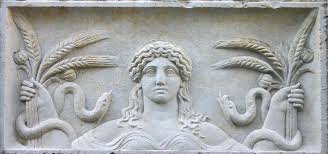
Temple relief of Demeter with grain, poppies, snakes, from Eleusis.
Initiation into the Eleusinian Mysteries involved the understanding that an ear of grain first must die in order to give new life (whether planted as seed, baked into bread, or made into beer). The phenomenon of death leading to life through the medium of a sacred marriage was celebrated in other archaic springtime festivals, such as those of Aphrodite / Adonis, Cybele / Attys, and Isis / Osiris), from which the Resurrection story of Christian Easter is directly descended. I believe something of these ancient customs survive in the women’s Tráta dance, whose every detail hints at the story of Persephone’s descent and return.
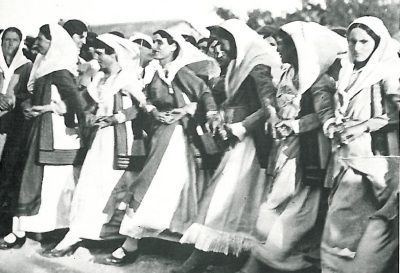
Women dancing the Tráta at Vilia on Mount Kithairon, Attiki, Greece.
In Megara, the annual ritual of the Tráta is one of the most significant events in the village. Women of all ages gather at the upper square, near the tiny church of ‘Saint John the Dancer’ with its miraculous spring believed to grant fertility. The women’s costumes used to feature strong black, white and red elements, the colours of the Triple Goddess and the three central figures of the Eleusinian drama (Hecate, Demeter and Persephone).
The old style of costume from Megara with strong black, white and red colours
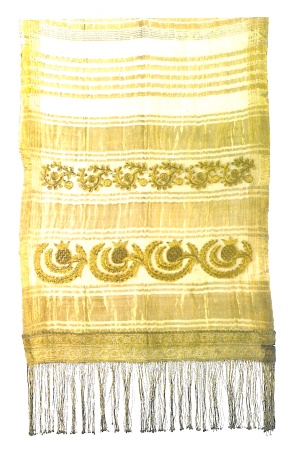
Now they are rich in silk, satins, and gold embroidery, with deep red aprons embroidered with flowing floral and vegetation motifs. The long, pale silk veils – symbol of initiation and the threshold between the worlds –  are embroidered with fertility symbols including wheat, sign of Demeter, and pomegranates, traditional food of the dead and symbol of prosperity and abundance chiefly associated with Persephone.
Silk and gold veil (bólia) from Salamína with design of enclosed pomegranates
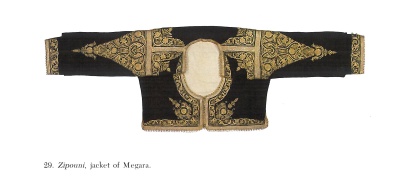
Velvet jacket (zipoúni) of Mégara with downwards-facing Goddess embroideries
The zipoúni or velvet jacket is richly embroidered in gold, and the sleeves feature the pre-Christian motif of the sun-headed Goddess; unusually, she is depicted head-down instead of right-side-up, as if indicating the direction of descent to the underworld.  The overall effect closely resembles the women on the frescoes in the 4th C. BCE Tomb of the Dancing Women in Apuglia, Italy.
Fresco from the ‘Tomb of the Dancing Women’, 4th C BCE, Apuglia, Italy
The kinetic motif of ascent and descent central to the myth of Persephone is dramatically emphasised by the pronounced zigzag of the dance pattern, visually mirrored in the basketweave handhold, and expressed again in the way the dance spirals completely in and out as you can see in the video.  The Tráta is one of the few traditional Greek dances which do this, in a labyrinthine movement of deepening and emerging which magnifies the inwards-outwards, ascending-descending theme.
In a reversal of normal procedure, young unmarried girls lead the older married women in the dance line: the daughter is the agent in this danced symbolic journey.  Among the mature women at the back of the line are the strongest singers, those able to sing loudly enough for the dancers at the front to hear, even when the circle is large and the dance line snakes and spirals around.
This spiralling movement is stunning to watch. In Mégara in the late 1940s, Kevin Andrews described it thus: ‘A long line of a hundred and fifty to two hundred women with gorgeous clothing holding hands across each other’s waist, simply moving slowly round and round the square… wearing head cloths of white silk falling in long folds over their backs and shoulders, plum-coloured velvet jackets tight and stiff with a profusion of gold embroidery, with lace at the cuffs, strings upon strings of coins hung across the breast, and silk aprons heavily embroidered over their long skirts that swirled over their gold-slippered ankles… There was no music anywhere.’
Rennell Rodd, in 1968, wrote that ‘the step appears to be extremely simple, not to say monotonous, and yet the precision with which it is accomplished, the simultaneousness of every movement, cannot be easy to acquire; while the general effect of these serpentining chains of linked figures, in their bright dresses and floating veils, advancing, retiring, and winding round, is particularly graceful and pretty.’

The women’s Tráta today still resembles the pictures painted by these witnesses of 50 and 75 years ago, but as with most Greek folk customs, major changes are underway.  John Tomkinson reports that the dancers used to ornament their songs with strange low twittering sounds like that of swallows (also a symbol of Persephone, and like her, associated with the returning spring) but the women no longer do this. By custom the Tráta was accompanied by the women’s own a cappella singing, yet now the mayor of Mégara hires an orchestra of male musicians to accompany the women. And whereas historically the women’s Tráta was the only dance permitted on this day, now boys’ dance groups come on at intervals to perform other Greek dances – Syrtos, Kalamatianos, Tsamikos – turning the ritual into a kind of performance complete with speeches by dignitaries, sellers of peanuts and balloons, and similar distractions.
However, even with all of these changes, the dance still expresses something valuable on behalf of those who watch, and for many the Tráta of Mégara remains a unique and important touchstone of the Easter festival. Each time I have gone, I have been touched by the powerful sense of rightness and peace which comes over the crowd as the women’s ritual dance unfolds before them, bringing a sense of wholeness and relief, just as in ancient times.
Recommended reading:

Shannon, Laura. “Ritual Dance in Greece, Then & Now,” 2011. http://laurashannon.net/articles/49-ritual-dance-in-greece-then-a-nowShannon, Laura. “Women’s Ritual Dances: An Ancient Source of Healing in our Time”. In Dancing On The Earth: Women’s Stories Of Healing Through Dance. J. Leseho and S. McMaster. 1st ed. Findhorn Press, 2011. 138-157.

Thursday, March 31, 2016

The Five Dakinis

Masks for The Five Wisdom Dakinis (2016)
The Dakinis are the most important elements of the enlightened feminine in Tibetan Buddhism. They are the luminous, subtle, spiritual energy, the key, the gatekeeper, the guardian of the unconditioned state. When you want to accomplish something, you always invoke the presence of the Dakinis.”
Lama Tsultrim Allione

Actually, I think I have to thank the humor, and lifting of the Depression I spoke of in the previous Post to...........the Dakinis.  I don't understand the wonderful Beings I recently made a collection of 5 masks for as a commission, but I honestly believe in spite of my ignorance, they have been helping to release me from..........myself.  My gratitude to the Sky Dancers!  And I hope that they are pleased, along with Mekare***, the Tantric dancer and teacher I made them for, with my humble efforts on their behalf.   May these masks be filled with transformative energies, and be of benefit to many others as Mekare dances with them, and teaches others to do so as well.


"The Dakini is a primordial female wisdom energy.  They are called "Skydancers" for they are completely free, able to travel between worlds and dimensions, free of the entanglements of the mind, and intimate with impermanence. They dance in limitless luminous space. Embodiments of the Dakini are said to do their practices in graveyards,  adorned with skulls and bone ornaments representing their intimacy with impermanence and their freedom from all fear.  They are ferocious and wise, primal and magical. Fierce allies and agents of change.  Their compassion is immense.
They can be tricksters of the most sublime order, terrifying and demanding of truth, and also the most kind of guides, playful and nurturing.  They break through barriers, invoke strength and power, guide us across the thresholds of awareness and change. 
Depictions of the Dakini show her with a crown of skulls, in a wreath of flame, teeth bared in ferocious  display like a tiger -  eyes piercing and somewhat terrifying but with a rare beauty.  The beauty of understainding, compassion, and hilarity shines forth.  In Tibetan Buddhist Tantra there are 5 Wisdom Dakinis, each having a specific gift of mind transformation - the transformation or transmutation  of the poisons of the mind into wisdom."...............Mekare

I immediately related to the Dakinis being associated with the Five Elemental forces, the "Medicine Wheel" of the  directions.  My sense is that they are like the Devas, primal beings and builders and creators, their concerns and origin are not necessarily human.  In this sense, they are elemental beings, associated with the 5 Directions,  invoked perhaps  just as Pagans invoke the Five Guardians or Powers of the Elements - Air, Fire, Water, Earth and Center or Aether.  Perhaps, like Kali dancing with Her skull necklace, or the dancing Bone People of the Mexican "Day of the Dead", the skulls and bones that adorn them represent a ferocious hilarity at the fears that beset us, the joy beyond death, beyond impermance.

"Dakini is a source of refuge. Besides taking refuge in the Three Jewels (Buddha, Dharma and Sangha), we also take refuge in the Three Roots (Guru, Yidam and Dakini): Guru as the root of blessings because he or she will guide us to attain enlightenment; Yidam as the root of accomplishment because through the skilful method of practicing on an Yidam or tutelary deity, one will realise the nature of his or her own mind; Dakini as the root of all enlightened activities since Dakini represents primordial wisdom.
Dakini is associated with spaciousness, therefore has the ability to give birth to limitless prospects of enlightened activities: pacifying, enriching, magnetising and destroying. Dakini also embodies the union of emptiness and wisdom. There is nothing more than this.  A Dakini has the ability to move freely in  space which is beyond thoughts and beyond fabrications. This is the state of awareness which is under control, stable and yet free. Everyone has the ability and the potentials to realise the Wisdom Dakini principles or nature within oneself."


The Green Karma Dakini,  Element of Air

 The transmutation of overwork, struggle, and competition  into  
all-accomplishing wisdom and enlightened activity.
Associated with Karma Dakini:  Fulfillment. Aware choice. 
Grace. Ease. The Tao. The Martial Artist aware in every direction. 
 Compassionate and capable action in the world.


The Red Padma Dakini, Element of Fire

 The transmutation of desire, lust, and grasping into discerning awareness.
Associated with Padma Dakini:  Compassion. Radiance. Magnetism 
in order  to bring benefit. Warmth. Comfort. Delight. Joy.


The Gold Ratna Dakini, Element of Earth

 The transmutation of arrogance and greed into equanimity and generosity.
Associated with Ratna Dakini:  Abundance. Stability.
The richness inherent in every moment and everything. 
Golden. Generosity. Enrichment.


The Blue Vajra Dakini, Element of Water

 The transmutation of confusion and anger into mirror-like wisdom.
Associated with Vajra Dakini:  Clarity.  Precision. Intelligence. Intuition. 
Reflection.  Clear seeing wisdom.


The White Buddha Dakini, Element of Space


 The transmutation of despair, depression, apathy, 
and disconnect into  illuminated spacious mind.  
Associated with Buddha Dakini:  Calm. Peace. Spacious. Soothing.
 Realization  of connection and the web of all. 
The restful state of enlightened mind.

Dakinis by Penny Slinger
http://journeyingtothegoddess.wordpress.com

***
mekareMEKARE is a Sacred Dancer, Artist, Storyteller, Shamanic Bodywork Therapist, and Visionary Creatrix who is passionate about embodiment, evolution, sacred dance, and healing.  She has traveled extensively, studying with indigenous healers and dancing ecstatically around the world, including performing for His Holiness the Dalai Lama in the Mandala Dance of the 21 Praises of Tara.
Mekare is an initiate on the Path of Pollen, an ancient shamanic tradition of the Honey Bee and the Hive. The potent energy of the sacred Bee flows through all of Mekare’s work … in dance, in healing, in love. A practitioner of Tibetan Buddhist Tantra, Mekare is a senior teacher and transmitter of the sacred dance/sadhana practice of The Mandala Dance of the 21 Praises of Tara, which is recognized by all four schools of Tibetan Buddhism as a direct lineage practice. She is also a transmitter of the powerful energies of the Five Wisdom Dakinis and is an adept in masked dance performance and ritual.  She leads classes, workshops and retreats internationally, offering many rich experiences of dance, ceremony, and transformational practices, as well as individual healing sessions/temple bodywork.
Mekare is the creatrix of Wild Honey Ritual Theater and Dance Prayerformance. Created as a medium for her ritual prayerformance offerings, Wild Honey is a dynamic sacred container for the magical cross-pollination that occurs when bringing together artists and innovators from many fields of experience. It is Mekare’s vision to gather and create this wild honey of extraordinary nourishment all around the globe. You can contact Mekare at: DevadasiM@aol.com and (US) (336) 971-1427.