Showing posts with label Richard Hames. Show all posts

Thursday, December 11, 2025

"From Tyranny to Tenderness": Article on Toxic Masculinity from Richard Hames


"The masculine principle, divorced from its complementary feminine aspect and elevated to a position of absolute supremacy, has become a kind of cognitive virus infecting our collective consciousness, distorting our understanding of what it means to exist in relationship with others and with the living Earth."

 An excellent deep dive into a very important need to change the patriarchal paradigm before it's too late. Nice to hear an intelligent and literate man approach the subject. A lot of women have been talking about it for......... well, quite a long time. But men aren't famous for listening to women. Maybe a few of them are now. I take the liberty of copying this excellent article here.


From Tyranny to Tenderness:
The Transformation of Masculine Consciousness

Richard David Hames
Dec 03, 2025

When we examine the multiple crises converging upon us at warp speed—ecological collapse, ingrained inequality, endless warfare, the erosion of democratic institutions and ideals—we actually see a pattern so pervasive it seems barely visible, like water to a fish.

This patten is suffused with a profound malaise which strikes at the very heart of our civilisational predicament—revealing itself not merely as political or economic dysfunction, but as a fundamental ontological error that has metastasized through millennia of human development. It's the pattern of masculine power. The masculine principle, divorced from its complementary feminine aspect and elevated to a position of absolute supremacy, has become a kind of cognitive virus infecting our collective consciousness, distorting our understanding of what it means to exist in relationship with others and with the living Earth.

The Hames Report - Limited Edition is a reader-supported publication. To receive new posts and support my work, consider becoming a free or paid subscriber.

This is not simply about men as biological entities, but about a worldview that has calcified into institutional forms, belief systems, and patterns of behaviour that perpetuate themselves through cultural transmission. The tragedy lies in how this framework mistakes its own limitations for universal truths, confusing the map for the territory, the constructed self for the ineffable reality of being. When we examine the archaeological record, we find that this wasn't always so—there existed periods and cultures where masculine and feminine principles danced in greater unity, where dominance wasn't confused with strength, where power meant the ability to nurture life rather than control or destroy it. This pattern of male tyranny extends far beyond simple gender politics to reveal a fundamental distortion in human perception itself, one that has shaped millennia of cultural evolution and now threatens the very continuity of life on Earth.

Manifestations of this distortion appear everywhere we look: in boardrooms where exclusively male executives make decisions affecting billions of lives, in religious hierarchies that claim divine authority while systematically excluding women from power, in the rape of ecosystems treated as mere resources for extraction, in the violence inflicted upon anyone who deviates from narrow definitions of acceptable identity or belief. Yet to interpret this as just a problem of individual bad actors would be to miss the deeper structural reality—that patriarchy represents a particular mode of consciousness that has institutionalised itself so thoroughly that even its victims often cannot imagine alternatives.

This consciousness rests upon a profound metaphysical error: the belief that the self exists as an independent, permanent, and absolute reality with the right—even the obligation—to impose its will upon the world. When this error becomes gendered, when it fuses with masculine identity and claims divine sanction through images of male deities and prophets, it creates a "cosmological tyranny" that extends from the heavens to the most intimate human relationships. Men come to believe not just that they should dominate, but that the very order of the universe depends upon their dominance.

The philosophical roots of this delusion run deep into the bedrock of Western civilisation, where Greek rationalism privileged the abstract over the embodied, where Christian theology placed spirit above matter, where Enlightenment thinking celebrated the autonomous individual while forgetting the web of relationships that make individuality possible. Each iteration reinforced the notion that to be fully human—and implicitly, to be male—meant to transcend the messy interdependence of biological existence and achieve a kind of god-like sovereignty over nature and society. Male became the default mechanism in a world-system designed and run by men for men.

Yet this mentality, however deeply entrenched, is neither universal nor inevitable. Indigenous cultures around the world have maintained different understandings, recognising the self as fundamentally relational, existing not in isolation but through connection with ancestors, descendants, the living Earth, and the spiritual dimensions of reality. Eastern philosophies have long taught that the separate self is maya, illusion, and that wisdom lies in recognising our fundamental interbeing with all that exists. Even within the Western tradition, mystics and poets have consistently challenged the dominant paradigm, pointing toward ways of being that honour connection over separation.

The transformation required, then, is not simply political or social but ontological—a fundamental shift in how we understand the nature of existence itself. For men, this means undertaking what amounts to a sacred deconstruction of identity, dismantling the elaborate architectures of domination that have been mistaken for strength, the armour of invulnerability that has been confused with maturity, the isolation that has been labeled as independence. This work begins not with new beliefs but with a profound encounter with sorrow—grief for the violence inherited and perpetuated, for the tenderness suppressed, for the connections severed in the name of proving masculine worth.

Through this sorrow, if genuinely embraced, comes the possibility of remembering what was lost when the masculine principle detached itself from the feminine, when mind declared independence from body, when humanity imagined itself separate from nature. It's an imperative that men rediscover themselves as sons of the Earth, not its masters, as equal participants in the web of life, not its supervisors. This remembering is evolution and not regression, not weakness but a more sophisticated appreciation of strength that recognises true power as the capacity to nurture life rather than dominate it.

The practical implications of such a shift would revolutionise every aspect of human society. Economics would transform from a system of extraction and accumulation to one of circulation and regeneration, acknowledging that wealth means health—that of communities, of ecosystems, and future generations. Governance would evolve from hierarchy to networks of mutual accountability, where power flows not from above but emerges from below through collective wisdom and shared responsibility. Education would shift from installing programmes to awakening consciousness, helping young people discover their unique talents while understanding their fundamental interdependence with all life.

Perhaps most crucially, spirituality would undergo a radical reimagining. The image of the divine as distant, vengeful, and male would give way to an understanding of the sacred as immanent in the web of relationships that sustain life. This doesn't mean abandoning the transcendent but rather recognising that transcendence and immanence are two facets of the same mystery, that the divine is as present in the soil beneath our feet as in the stars above our heads, and as fully embodied in women's wisdom as in men's.

For this transformation to occur, men must become interns of those who have maintained connection to life's deeper rhythms—women who never forgot the wisdom of cycles and seasons, indigenous peoples who still know the Earth as a living being deserving reverence, children who haven't separated wonder from knowledge, and the natural ecosystems that show us how reciprocity and diversity create resilience as well as beauty. This apprenticeship requires cultivating humility, perhaps the most challenging virtue for those trained to see vulnerability as weakness rather than as the portal to authentic strength.

Men must discover new sources of meaning and identity rooted not in dominance but in service, not in separation but in communion, not in permanence but in conscious participation in the eternal dance of creation. This is not about diminishing masculine energy but about allowing it to mature into its fullest expression—the protector who creates conditions for all life to flourish, the warrior who battles against the forces of destruction within and without, the lover who embraces the world with tenderness and strength, the sage who has learned that true wisdom begins with acknowledging how little we know.

Whether our species is capable of navigating the evolutionary bottleneck ahead may depend on how quickly and thoroughly this transformation occurs. The crises we face are fundamentally crises of consciousness, symptoms of a worldview that has outlived its usefulness and now threatens to destroy what it once sought to control. Patriarchy of the most toxic kind will end—the mounting pressures of ecological and social breakdown ensure that it cannot continue indefinitely. The question is whether men can consciously participate in its transformation or whether they will cling to dominance until the systems supporting it collapse entirely, potentially taking much of life on Earth with them.

The work of transforming masculine consciousness becomes not just a matter of gender justice but of species survival, not just a social imperative but a spiritual calling to remember what it means to be fully human. The future asks men to release their death grip on control and open their hands to receive the gifts that only vulnerability and connection can bring, to trade the illusion of separation for the reality of interbeing, to discover that their deepest fulfillment comes not from power over but from power with—the creative power that emerges when all beings are free to contribute their unique gifts to the larger whole.

This metamorphosis calls for nothing less than a reimagining of what it means to be male in the twenty-first century and beyond. The old stories that equated masculinity with control, rationality with superiority, and independence with maturity have exhausted themselves. They lead only to isolation, ecological devastation, and the perpetuation of cycles of violence that diminish everyone, including the men who appear to benefit from them. The new story waiting to be born recognises masculinity as one essential tonality in the symphony of existence, finding its truest expression not in solo performance but in harmony with all other voices.

The evidence increasingly suggests that those cultures and communities that embrace gender balance, that respect both masculine and feminine ways of knowing and being, demonstrate greater resilience, creativity, and capacity for dealing with complexity. They make better decisions because they draw on the full spectrum of human wisdom. They create more ingenious solutions because they aren't limited by rigid hierarchies that silence diverse views. They build more enduring systems because they understand that lasting strength comes from interdependence, not control.

In this light, the transformation of male consciousness from tyranny to tendersness represents one of the most urgent evolutionary challenges facing our species. It requires men to do the difficult inner work of examining their inherited beliefs, challenging their conditioned reflexes, and opening to ways of being that their culture may have taught them to fear or despise. It asks them to find courage in the willingness to be vulnerable, not in certainty but in the capacity to hold complexity, not in answers but in the quality of their questions.

Some, like Jordan Peterson, will argue that my call for transformation represents an attack on masculinity itself, that hierarchies are natural and necessary, that traditional male virtues of strength, rivalry, and rational mastery have built our civilisation and must be preserved. This perspective, increasingly vocal in our polarised times, sees the crisis differently—not as too much masculine dominance but too little masculine order, not as excess control but as dangerous feebleness. Yet this defense of traditional masculinity basically misreads both our predicament and our potential.

The ecosystems collapsing around us, the epidemic of male suicide and isolation, the endless cycles of violence and war—these are not symptoms of insufficient masculine control but of its exhaustion as organising principle. Nature itself teaches us that monocultures inevitably fail, that systems which cannot adapt become extinct, that resilience emerges from diversity and interconnection rather than domination.

For me the choice is not between masculine order and feminine softness, but between conscious evolution and unconscious collapse. Those who cling to dominant hierarchies as the "natural" order forget that consciousness itself is nature's experiment in transcending its own limitations. The transformation of masculine consciousness from tyranny to tenderness is not a betrayal of male strength but its maturation into a form of power that can actually sustain life rather than destroy it.

This is the great remembering our times demand—not a return to an imagined past of unchallenged male authority, but an evolution toward a future where masculine and feminine principles unite in service to life's continuation.

Thursday, July 31, 2025

Collapse and Rebirth: Richard D. Hames


"These approaches fail because they refuse to confront the core issue: the lifestyle and infrastructure of modern industrial civilization are fundamentally incompatible with the biophysical realities of our planet. True sustainability would require radical reductions in energy and material throughput, dramatic decreases in consumption levels, and a fundamental restructuring of economic and social systems—changes so profound that they would amount to the "end" of civilization as we know it. "

 https://richarddavidhames.substack.com/p/beyond-the-event-horizon

I was deeply moved when I encountered this article on Substack by philosopher and futurist Richard David Hames.  He so eloquently and succinctly says it as it is, now.  Where do we go from here?  We are living, I believe and agree with the author, in the chaos of end stage capitalism, cultural collapse, and in the U.S., governmental collapse,  all set against the global environmental catastrophe of climate change.  

People like me, and scientists, mythologists, writers, artists, politicians and many others, have been talking about "paradigm change" and "re-mything culture" for a long time.  Here we are, and where do we go from here?  How can we "compost" the "detritus of our failing civilization into the foundations" of what is to come? How do we navigate in a collapsing system, and also such profound cultural denial? I take the liberty of sharing this important article here, as this Author speaks I believe so well to what is occuring.  I  highly recommend to any who read this post subscribing to Mr. Hames Substack Blog.  He is one of those who are "Realists of a larger Reality"

"Our task is not to prevent collapse, we've already past the point of no return. Our task is to compost the detritus of our failing civilization into the foundations for whatever emerges from this vast transformation. This requires grieving the loss of the familiar world while remaining open to possibilities that we cannot yet imagine. It means cultivating resilience and adaptability rather than efficiency and growth. It demands that we rediscover our embeddedness within the living systems that sustain all life, abandoning the mythology of separation that has brought us to this threshold." 


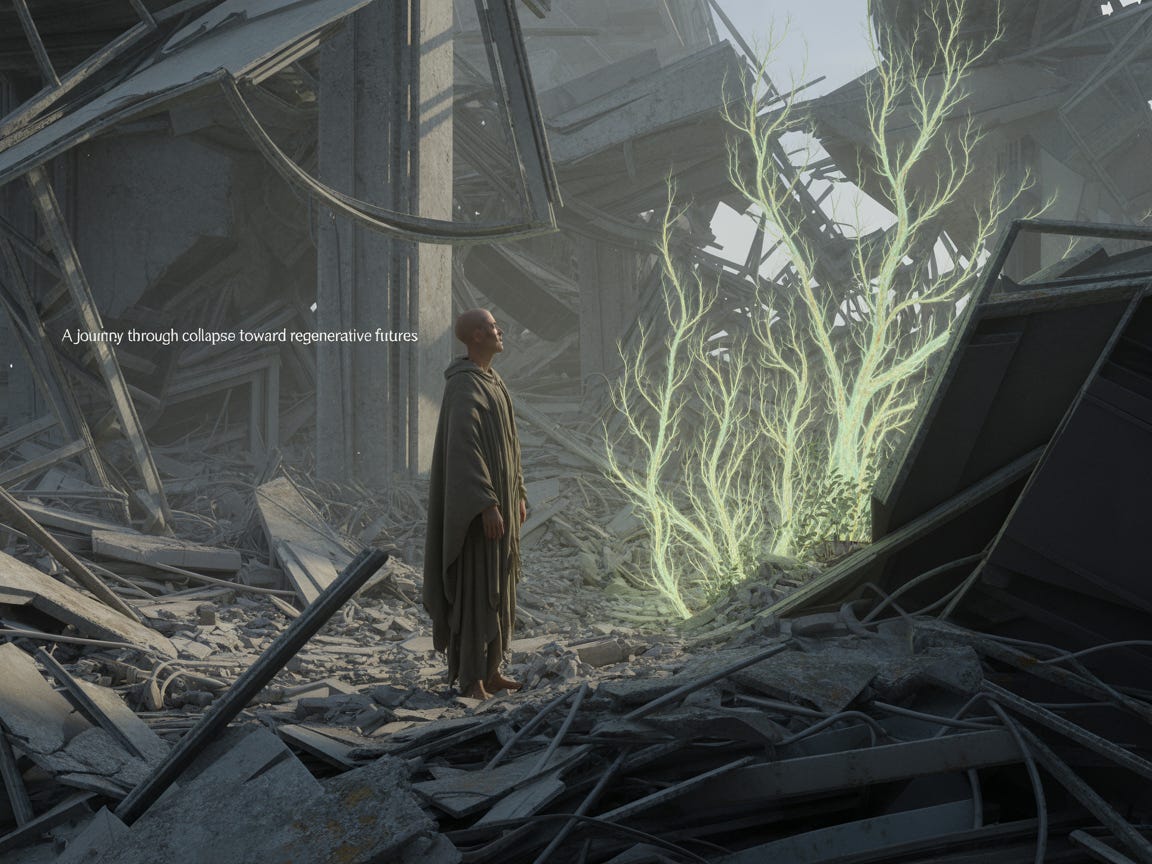
A Journey Through Collapse Toward Regenerative Futures

The symptoms manifest across every domain of planetary function: carbon cycles destabilised by the combustion of ancient organic matter, nitrogen cycles overwhelmed by industrial fertiliser production, hydrological systems disrupted by massive infrastructure projects, and biodiversity hemorrhaging through habitat destruction and chemical contamination. These are not separate crises, they are interconnected expressions of a fundamental mismatch between the operational logic of industrial civilisation and the biophysical constraints that govern all life on this planet.

Our species has consumed the geological inheritance of millennia in mere centuries, burning through fossil fuels accumulated over hundreds of millions of years, strip-mining the planet's mineral wealth, and harvesting renewable resources—forests, fisheries, fertile soils—at rates that surpasses nature's ability to replenish them. Meanwhile, we have overwhelmed the biosphere's waste-processing capacity, saturating the atmosphere with carbon dioxide, choking the oceans with plastic, and poisoning ecosystems with an ever-expanding cocktail of synthetic chemicals that natural systems cannot break down or incorporate.

To understand how we arrived at this juncture, we must trace the arc of human development from our earliest emergence as a species. Our ancestors evolved with biological imperatives perfectly suited to their environment: survive, reproduce, consume available resources, and expand into new territories when possible. These instincts served us well in a world where human populations were tiny and technical capabilities limited. But our capacity for innovation—the discovery of fire, the development of tools, the evolution of intricate social cooperation—began to allow us to transcend natural constraints in ways that would ultimately prove catastrophic.

The agricultural revolution marked a pivotal turning point, transforming human societies from nomadic hunter-gatherers into settled civilizations capable of generating food surpluses. This abundance enabled population growth, social stratification, and the concentration of power in urban centres. More notably, it fundamentally altered our relationship with the natural world, shifting from participation within ecological systems to domination over them. Growth became not merely an opportunity but an imperative, both for survival in competitive environments and as a marker of civilizational success.

The industrial revolution accelerated these trends exponentially, as the discovery and exploitation of fossil fuels provided access to energy stores that had been accumulating in Earth's crust for eons. Coal, oil, and natural gas became the foundation for unprecedented population growth, processes of production, and material consumption, enabling a way of life that seemed to transcend all previous limitations. This fossil-fuelled bonanza created the illusion that perpetual growth was not only possible but natural, obscuring the fundamental reality that we were drawing down finite stores of ancient sunlight at rates millions of times faster than they had been created.

The drivers of our current predicament operate at multiple levels, from the biological to the cultural to the systemic. At the most fundamental level, we remain governed by evolutionary programming that compels us to consume and reproduce without regard for long-term consequences. Our brains evolved to respond to immediate threats and opportunities, not to process abstract dangers that unfold over decades or centuries. In competitive environments, those who exploit resources most aggressively tend to outcompete those who exercise restraint, creating a relentless "race to the bottom" that plays out between individuals, corporations, and nations.

It's worth noting here that while evolutionary drives and competitive systems incentivise short-term exploitation, indigenous wisdom demonstrates that culturally evolved practices—like stewardship, restraint, and cyclical thinking—can realign human behaviour with long-term sustainability, offering pathways to overcome our more self-destructive programming.

Nevertheless, that does not change our present predicament. We have constructed elaborate belief systems that not only justify but actively promote behaviours that are driving us toward collapse. The mythology of technological salvation convinces us that innovation will always provide solutions to whatever problems previous innovations have created, even as our track record demonstrates that new technologies typically generate more problems than they solve, often with greater complexity and unintended consequences. Our economic systems in particular are predicated on the assumption of endless growth, requiring constant expansion of production and consumption to maintain stability, despite the mathematical impossibility of infinite growth on a finite planet.

Most fundamentally, the worldview of human supremacy that underlies modern civilisation portrays our species as separate from and superior to the natural world, justifying the treatment of ecosystems as mere resources to be exploited rather than living systems of which we are an interdependent part. This conceptual separation enables us to externalize the costs of our activities, treating the biosphere as both an inexhaustible source of materials and an infinite sink for wastes.

The tragedy of our situation becomes apparent when we examine the responses that have emerged to address these mounting crises. Despite our growing awareness of environmental degradation and social dysfunction, proposed solutions almost invariably focus on technological fixes and economic adjustments that go out of their way to preserve the fundamental structures and assumptions of industrial civilisation.

Green technologies promise to maintain current consumption levels while reducing environmental impact, ignoring the resource requirements and environmental costs of manufacturing and deploying these technologies at scale. Economic reforms propose to decouple growth from resource consumption and environmental degradation, despite the absence of any historical precedent for such decoupling at the scales and timeframes required.

These approaches fail because they refuse to confront the core issue: the lifestyle and infrastructure of modern industrial civilisation are fundamentally incompatible with the biophysical realities of our planet. True sustainability would require radical reductions in energy and material throughput, dramatic decreases in consumption levels, and a fundamental restructuring of economic and social systems—changes so profound that they would amount to the "end" of civilization as we know it. The resistance to such transformations is understandable but ultimately irrelevant, because these changes will occur whether we choose them or not.

We are already witnessing the early stages of this great unraveling. Multiple planetary boundaries have been crossed, triggering feedback loops that are accelerating environmental degradation beyond our ability to control or reverse. Thawing permafrost releases vast quantities of methane and carbon dioxide, amplifying heating trends. Melting ice reduces the planet's ability to reflect solar radiation back to space, further accelerating temperature rise. Deforestation and ecosystem destruction eliminate carbon sinks while increasing atmospheric greenhouse gas concentrations. These processes are now largely autonomous, continuing regardless of human interventions.

The social and political dimensions of collapse are equally evident. Rising inequality and resource scarcity fuel social unrest and political volatility. While national political horseplay descends into sheer spectacle, conventional governance structures are proving inadequate to address challenges that transcend state boundaries and operate on timescales that exceed electoral cycles. Progressive and conservative political movements alike remain trapped within paradigms which incorrectly assume the possibility of maintaining current civilisation through minor modifications, unable to acknowledge the biophysical limits that constrain all human activities.

Unless we stumble upon a suite of technological miracles, the depletion of cheap, easily accessible energy sources ensures that the industrial system cannot sustain itself indefinitely. As the energy return on energy invested for fossil fuel extraction continues to decline, the economic foundation of modern civilization becomes increasingly unstable. Complex supply chains that depend on cheap transportation fuels become vulnerable to disruption. The elaborate financial systems that facilitate global trade require constant growth to service increasing debt burdens, creating instability that cascades through interconnected economic networks.

Collapse is not a future event to be avoided but a present reality to be navigated. Economic instability, resource scarcity, extreme weather events, and social fragmentation are already disrupting the normal functioning of industrial society. The question is not whether collapse will occur but how rapidly it will unfold, what forms it will take in different regions and communities, and what we must do to adapt.

This recognition, while painful, offers the possibility of liberation from the illusions that prevent us from responding appropriately to our circumstances. Accepting that industrial civilisation cannot be sustained allows us to stop investing energy in futile attempts to preserve the unsustainable and instead begin the work of adaptation and transformation. Living with the reality of collapse means slowing down, becoming more present in our immediate environments, and rediscovering beneficial ways of life that operate within ecological limits rather than in opposition to them.

The end of industrial civilisation doesn't necessarily mean the end of human culture or the possibility of flourishing communities. Throughout history, human societies have demonstrated remarkable ingenuity in developing ways of life adjusted to their local conditions and available resources. The knowledge and skills required for such adaptation still exist, though they have been marginalised by the homogenising forces of industrial development.

Our task is not to prevent collapse, we've already past the point of no return. Our task is to compost the detritus of our failing civilization into the foundations for whatever emerges from this vast transformation. This requires grieving the loss of the familiar world while remaining open to possibilities that we cannot yet imagine. It means cultivating resilience and adaptability rather than efficiency and growth. It demands that we rediscover our embeddedness within the living systems that sustain all life, abandoning the mythology of separation that has brought us to this threshold.

The transition ahead will be neither smooth nor equitable, but it is inevitable. Our choice is not whether to undergo this transformation but how consciously to participate in it. By releasing our attachment to the myths and structures of industrial civilisation, we create space for ways of being that honour the limits and gifts of our earthly home. In the ruins of the old world, the seeds of the new are already beginning to germinate. It's an exciting time for those with a pioneering spirit. A time for real hope that we're able to generate a world of peace and prosperity.

The Hames Report - Limited Edition is a reader-supported publication. To receive new posts and support my work, consider becoming a free or paid subscriber.