
"What might we see, how might we act, if we saw with a webbed vision?
The world seen through a web of relationships…as delicate as spider’s silk,
yet strong enough to hang a bridge on.”
Catherine Keller, From a Broken Web: Separation,Sexism and Self 1
I seem to have writer's block these days, and so I find myself revisiting earlier posts. Here is one I'm proud of, inspired by Grandmother Spider Woman. I come back to it again and again especially now, as it seems, with global warming and the corruption and authoritarianism that has overtaken the U.S., it is more than ever timely and timeless. I think it gives me hope.
I've begun using the term "Inter-dependence" instead of the tamer, perhaps more polite "inter-connectedness"..... because, frankly, unless we as a common humanity create civilizations, economies, and religions based on a very real mutual dependency with virtually every other living being and phenomena on this magnificent living planet we have been given the privilege to be a part of...... pretty soon at that........ we're going to, as they say, go the way of the dinosaurs. More appropriately, the Dodo, which was an early statistic in the 6th Extinction.
Sorry, a moment of despair there.
My path on the trail of Spider Woman has been fraught with synchronicities, which I have come to think of as touchstones along the way. Synchonicities, to me, are a mystical part of the overlay (and the foundational "under") of the metaphor Dr. Keller writes of. As I write about "A Webbed Vision" , for example, I note that for the past weeks a spider has made its home on the ceiling directly above the keyboard where I write. I have come to think of that spider as my muse - perhaps, fancifully, she is Spider Woman's envoy, weaving its patient web just above my head, reminding me each day of a vision I want to hold.

In her 1989 book Dr. Keller does not speak of the Native American Goddess Spider Woman, but she often references the Greek myth of "Penelope". Penelope is a name with ancient origins that derive from an archaic Greek word meaning "with a web on her face". It is likely that Penelope was originally a Fate or Oracular Goddess before she was later demoted in patriarchal Greek mythology to the faithful wife of Odysseus, weaving and un-weaving a shroud to avoid her suitors (it's always interesting the way myths are transformed to suit the evolving mythos and power base of different cultures). Yet within the earlier context of a more egalitarian society, "Penelope" would be one who could "see" and "weave" the beginnings and the ends of a life. She might have been personified with a loom before her, or spinning a thread. Taking the metaphor further, such a Goddess would "see" the inter-dependencies between all things, the Great Web spreading out across the landscapes of life.
 Pueblo mythology tells that when each of the previous worlds ended in catastrophe, it was Spider Woman who led the people through the sipapu, the kiva (or birth canal) into the next world. As such Spider Woman is the divine midwife for the birth of each new age.


If each of us could, like Penelope, "see" ourselves holding a thread that originates with all of those who came before us - and touches all of those who will come after us - how indeed might we see, and act?
As I watch the ongoing corporate greed that is eroding not only democracy, but the very life of our planet, and the unreasoned ideology of capitalism (as opposed to local free enterprise) that makes it possible for this new monarchy of the 1% to arise, I wonder sometimes if there is any hope for the future at all. If I am not my brother's and sister's keeper, and they mine - who is? Monsanto? Walmart? A civilization, indeed the raising of a single child, is a grand collaboration among many, and it might be said from that "webbed vision" of societies that the exploiters and warlords pounding their chests and sitting like dragons on their stolen gold....... are the parasites of a civilization, rather than any appropriate leaders.
We urgently need pragmatic ways to create and envision expanding community, which can be simplified to a fundamental sense of belonging. Beyond that, we need an ethos and mythos that supports the fundamental, and foundational, understanding of inter-dependency. If America was not a culture that idealizes "rugged individualism" where "good fences make good neighbors" what other kinds of values might enhance the quality of life for us (and perhaps the very survival of our species) along with an extended community of many other species we share our world with?
In tribal societies, survival depended on cooperation, as well as the collective ability to adapt continually to new environmental challenges, be it drought, invaders, or the exhaustion of resources. The mythic foundation of any tribe (or civilization) is ultimately the template upon which they stand; a culture with a rigid mythos that cannot adapt and change is doomed to collapse. Without a significant mythos of co-dependency in the face of global ecological crisis, the coming collapse of our civilization is apparent.
The Latin origin of the word "religion", religios, means to "link back". To rejoin with the greater and divine whole in some way. In my opinion, many of today's religions, at least in their institutionalized forms, fail in communicating this ultimate "webbed vision" - in fact, as tribal social control mechanisms with millenia of often mutually contradictory doctrines behind them, they do exactly the opposite. They separate, create discord and fear, and damn those who do not share their cultural or philosophical constructs. Religions are essentially concretized mythologies - concretized communal stories.
The quote above, from theologian Catherine Keller, has been deeply important to me. I first read her book "From a Broken Web" in 2008, when I was pursuing my "Hands of the Spider Woman" Community Arts Projects. The first project was at the Midland Center for the Arts (with the Alden B. Dow Creativity Center) in Michigan, then at the Creative Spirit Center, also in Midland (with Kathy Space), and last when I was a Resident Artist at the Henry Luce Center for the Arts and Religion in Washington D.C. To some extent, that quote informs the origins of this Blog.
So, once again I look back to this article, repeating its message again (written in 2008 originally). Repeating the vision the Great Weaver gave me back then...........
 |
| "Spider Woman" from "Restoring the Balance" 2004 |
A WEBBED VISION (2008)
Perhaps because I live in the Southwest, the "legends of the Spider Woman" have always fascinated me as I encountered Her in native American art. Spider Woman is an ubiquitous Creatrix found throughout the Americas, with her earliest known origins among the Maya of South America. Spider Woman manifests among the Navajo and the Pueblo Peoples of the Southwest as the "great Weaver". Among the people of the Keresan Pueblo she is also called Tse Che Nako, the "Thought Woman" who weaves the worlds into being with the stories She tells. Within this metaphor of the "great weaver", Spider Woman waits at the center of the Web of life, within which we are all connected, interwoven and co-creating.
Ts' its' tsi' nako, Thought-Woman, the Spider is sitting in her room thinking of a story now: I'm telling you the story She is thinking.
Keresan Pueblo Proverb from Carol Patterson-Rudolph 2
My path on the trail of Spider Woman has been fraught with synchronicities, which I have come to think of as touchstones along the way. Synchonicities, to me, are a mystical part of the overlay (and the foundational "under") of the metaphor Dr. Keller writes of. As I write about "A Webbed Vision" , for example, I note that for the past weeks a spider has made its home on the ceiling directly above the keyboard where I write. I have come to think of that spider as my muse - perhaps, fancifully, she is Spider Woman's envoy, weaving its patient web just above my head, reminding me each day of a vision I want to hold.
In her 1989 book Dr. Keller does not speak of the Native American Goddess Spider Woman, but she often references the Greek myth of "Penelope". Penelope is a name with ancient origins that derive from an archaic Greek word meaning "with a web on her face". It is likely that Penelope was originally a Fate or Oracular Goddess before she was later demoted in patriarchal Greek mythology to the faithful wife of Odysseus, weaving and un-weaving a shroud to avoid her suitors (it's always interesting the way myths are transformed to suit the evolving mythos and power base of different cultures). Yet within the earlier context of a more egalitarian society, "Penelope" would be one who could "see" and "weave" the beginnings and the ends of a life. She might have been personified with a loom before her, or spinning a thread. Taking the metaphor further, such a Goddess would "see" the inter-dependencies between all things, the Great Web spreading out across the landscapes of life.

According to Hopi cosmology, we have now entered the "Fifth World". It is interesting that, in contemporary Neo-Pagan practices, there are 5 Elements that symbolize the "great Circle". The Fifth Element is called "Center", and is represented with the color white, the union of all colors. It is the last Element, and symbolizes the universal force or Aether that unites all the other Elements.
I cannot resist imagining that the World Wide Web might just be is Spider Woman's latest appearance!
I cannot resist imagining that the World Wide Web might just be is Spider Woman's latest appearance!
“In Hopi cosmology Spider Woman was the first to weave. Her techniques and patterns have stood the test of time, or more properly, the test of timelessness.…..…..Weaving is not an act in which one creates something oneself – it is an act in which one uncovers a pattern that was already there.”
John Loftin 3As we confront the universal catastrophe of climate change, it seems to me that this is a significant and appropriate metaphor. Indeed, a significant Prophecy: for what we now confront concerns not just a tribe or nation, but all beings upon planet Earth. We must evolve a new, global paradigm for this Fifth Age if we are to survive. Spider Woman, bringing a vision of the Great Web of life, once again must be the midwife as She makes visible the connections, the strands of the Web, whether we speak of ecology, economy, quantum physics, or integral psychology. In our essence, as Jungian psychologist Ann Baring has said, "we are one".
" The new myth manifests through the triple influence of quantum physics, depth psychology and the ecological movement suggests that we are participants in a great web of life, each one of us indissolubly connected with all others through that invisible field. It is the most insidious of illusions to think that we can achieve a position of dominance in relation to nature, life or each other. In our essence, we are one."
Anne Baring, Awakening to the New Story 4How indeed, as an evolving global society, would we think and act, if we saw, like Penelope (or Grandmother Spider Woman) "with a webbed vision"? Would we be able to change the catastrophic course of ecological destruction if we had such a theology based upon Relationship instead of Domination? If our reasoning, and our way of seeing, was inclusive rather than dissectionist? If instead of valuing competition and the "alpha" winner, we valued consensus? If instead of "fight and flight" in the face of danger, we instead pulled out the defense tactic found among female monkeys of "tend and befriend"? If instead of renunciate, hierarchical religions that turn us away from nature and Earthly existence toward an abstract "heaven" or "nirvana", we saw ourselves as profoundly embedded in the sacred body and evolving soul of our living planet?
"The question is not so much "What do I learn from stories" as "What stories do I want to live?"
David R. Loy, "The World is Made of Stories" 5

If each of us could, like Penelope, "see" ourselves holding a thread that originates with all of those who came before us - and touches all of those who will come after us - how indeed might we see, and act?
"The New Story coming into being is that the whole universe is a unified field. The world we experience is like a minute excitation on the surface of an infinite cosmic sea which sustains not only our world, but the entire Cosmos. We live within a cosmic web of life which underlies and connects all life forms in the universe and on our planet. Through a vast network of electro-magnetic fields we are connected to the earth, the sun and the hundred billion galaxies. So we are not separate from any aspect of planetary or cosmic life. "Anne Baring, Awakening to the New Story 6
As I watch the ongoing corporate greed that is eroding not only democracy, but the very life of our planet, and the unreasoned ideology of capitalism (as opposed to local free enterprise) that makes it possible for this new monarchy of the 1% to arise, I wonder sometimes if there is any hope for the future at all. If I am not my brother's and sister's keeper, and they mine - who is? Monsanto? Walmart? A civilization, indeed the raising of a single child, is a grand collaboration among many, and it might be said from that "webbed vision" of societies that the exploiters and warlords pounding their chests and sitting like dragons on their stolen gold....... are the parasites of a civilization, rather than any appropriate leaders.
We urgently need pragmatic ways to create and envision expanding community, which can be simplified to a fundamental sense of belonging. Beyond that, we need an ethos and mythos that supports the fundamental, and foundational, understanding of inter-dependency. If America was not a culture that idealizes "rugged individualism" where "good fences make good neighbors" what other kinds of values might enhance the quality of life for us (and perhaps the very survival of our species) along with an extended community of many other species we share our world with?
"The Rugged Individualist" cheers when needy people are deprived of food, battered women are deprived of protection from brutal husbands, children are deprived of education, because this is "getting government off our backs.”
Philip Slater, The Chrysalis Effect: The Metamorphosis of Global Culture 6"Alpha male" individualism fails in every way to communicate that we live within a web of human and environmental inter-dependency, a web that is unimaginably vast and also very intimate. This is the "Webbed Vision" that sees and recognizes the links that must be restored. A successful adult is so because of parents, siblings, friends, teachers, community resources, the backdrop of nature and environment, global society.........and distant ancestors that enabled him or her to be born. Without a sense of belonging and contributing to that continuum as it reaches into both the past and into future generations, human beings end up feeling alienated, disposable, and without a sense of purpose. Which is what an unsustainable, insatiable consumer system, as a placebo for the pain of spiritual and communal isolation, feeds on.
 |
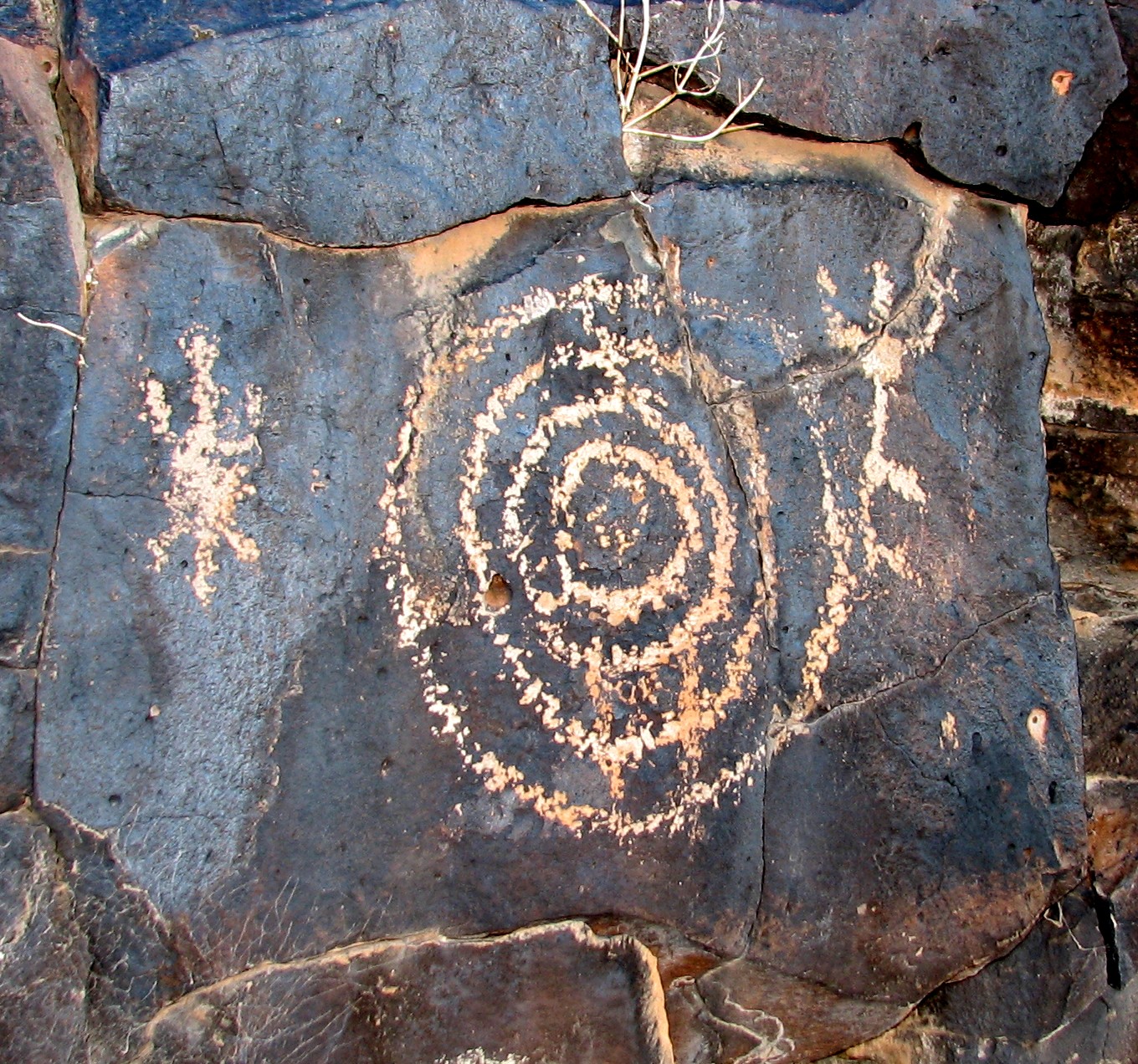
| "Spider Woman's Cross" motif found in Navajo art and weaving |
In tribal societies, survival depended on cooperation, as well as the collective ability to adapt continually to new environmental challenges, be it drought, invaders, or the exhaustion of resources. The mythic foundation of any tribe (or civilization) is ultimately the template upon which they stand; a culture with a rigid mythos that cannot adapt and change is doomed to collapse. Without a significant mythos of co-dependency in the face of global ecological crisis, the coming collapse of our civilization is apparent.
"The culture that is holistic is holistic because its reasoning structure is holistic. The problem we have with holism is that our reasoning is fragmentary, dissectionist, it removes us from relating things, it structures things in separate compartments in order to "have control".
Rafael Montanez Ortiz 7
The Latin origin of the word "religion", religios, means to "link back". To rejoin with the greater and divine whole in some way. In my opinion, many of today's religions, at least in their institutionalized forms, fail in communicating this ultimate "webbed vision" - in fact, as tribal social control mechanisms with millenia of often mutually contradictory doctrines behind them, they do exactly the opposite. They separate, create discord and fear, and damn those who do not share their cultural or philosophical constructs. Religions are essentially concretized mythologies - concretized communal stories.

What stories are so many people and institutions telling about the world we live in, the 21st Century world of global civilization? How do these sacred stories - most of them with their origins in ancient tribal societies existing in a very different kind of world - serve, or fail, the world of today?
Returning to "religios", the "linking back" to what is sacred, patriarchal Renunciate religions that teach us to renounce the world, the body, and the demands of relationships of every kind, either in service of some abstract "better place" or teachings that degrade earthly life as "impure" or "unreality"..............will not help us. More importantly, they certainly will not help those who must come after us to live in a diminished world. In traditional theological systems of patriarchal religions, divinity is placed "elsewhere", be it the literally conceived paradise that awaits the faithful, heaven, or nirvana. Equally, this renunciation of life can include more elegant abstractions that teach us that "this is not real" but fail to describe what actually "is real" in a way that is tangible. Renunciation of a false, dangerous, or corrupt world is a prime theme to be found in patriarchal religions, religions that have their origins in violent warrior ideology and warrior lifestyles. It might be said, for an example, that the Old Testament God Yahweh, with all his punishments and rules, is a classic example of an authoritarian, merciless, warrior "sky god".
And more subtly, the New Age message that "this experience is not real" which drives devotees to seek "the real world" found in some divine, other-worldly, perfected abstraction once we are "purified" or "surrender" in order to have one's consciousness raised sufficiently. Which often must happen through an authoritarian Guru or spiritual leader, with many of the attendant social abuses.
To speak of "oneness", to address creating a cohesive vision of holism that is appropriate to the world we live in today, mythic systems that include creative diversity within that "oneness" are needed. Myths and symbols that can include many gods and goddesses, many voices and languages, and many ways to the truth instead of simply eliminating the competition. Further, our world myth can no longer be simply a human world myth - it must include many evolutions, many other beings within the intimacy of ecosystems. If we're to survive into sustainability.
"We live in a world today in which the problems we face are all planetary" Philip Slater commented in his last book The Chrysalis Effect, “the polarization and chaos we see in the world are the effect of a global cultural metamorphosis". Slater's view was ultimately hopeful - that we are witnessing the chaos of a new evolution. That metamorphosis he spoke of, I personally believe, is based on the realization of inter-dependency with all life. In his view, this is humanity's childhood's end. We are called now to the world, each other, and the miracle of life, with a "Webbed Vision".
As the New Year approaches, I personally would like to call on artists, writers, musicians, storytellers, and all other "cultural creatives" to help to make a new mythology for the global tribe. The writer Ursula Leguin called them "realists of a larger reality". Among the Navajo (Dine`) infant girls still have a bit of spider web rubbed into their hands so they will "become good weavers". May we all now rub a bit of spider web into our hands for the work ahead of us ..........and, like Penelope, may we all now see "with a web on our faces".
“Hope now lies in moving beyond our past in order to build together a sustainable future for all the interwoven and interdependent life on our planet, including the human element. We will have to evolve now into a truly compassionate and tolerant world – because for the first time since the little tribes of humanity’s infancy, everyone’s well being is once again linked with cooperation for survival. Our circle will have to include the entire world.
Joel Kramer and Diana Alstad, The Guru Papers: Masks of Authoritarian Power 8

1) Keller, Catherine, From a Broken Web: Separation, Sexism, and Self,
1988, Beacon Press
2) Patterson-Rudolph, Carol, On the Trail of Spider Woman, 1997, Ancient City Press.
3) Loftin, John D., Religion and Hopi Life, 2003, Indiana University \
Press
4) Baring, Anne, "Awakening to the New Story", 2013, from her website:
https://www.annebaring.com/anbar14_comment.htm
5) Loy, David R., The World is Made of Stories, 2010, Wisdom Publications
6) Baring, Anne, "Awakening to the New Story", 2013, from her website:
https://www.annebaring.com/anbar14_comment.htm
7) Slater, Phillip, The Chrysalis Effect: The Metamorphosis of Global Culture, 2008,
Sussex Academic Press
8) Ortiz, Rafael Montanez Ph.D., interview with Lauren Raine, unpublished manuscript
(1989)
9) Alstead, Diana and Kramer, Joel, The Guru Papers: Masks of Authoritarian Power,
1993, Frog Books


%20(1).jpg)


